
As planning accelerates for sixth-generation mobile networks, Australian researchers are signalling a potential shift in how wireless infrastructure inside buildings, devices and data centres could be designed, with implications for performance, energy consumption and scalability.
A collaboration between Monash University and The University of Melbourne has produced a quantum-inspired approach to optical wireless communication that aims to address some of the most persistent challenges facing 6G. The research, published in IEEE Communications Letters, focuses on environments where conventional wireless technologies struggle most — dense indoor spaces, high-performance computing systems and data-rich enterprise settings.
While public discussion around 6G often centres on faster smartphones, the researchers argue that a critical bottleneck lies deeper in the network. Future systems will need to support high-speed links not only between user devices, but also between chiplets inside computers, across smart devices in offices, and within data centres where space, heat and cabling constraints are increasingly severe.
Professor Malin Premaratne from Monash University said traditional wireless approaches face fundamental limits in these environments. Interference increases as device density rises, reliability drops in complex layouts, and energy consumption and heat output constrain performance. Scaling such systems typically requires additional cabling, undermining flexibility and driving up cost.
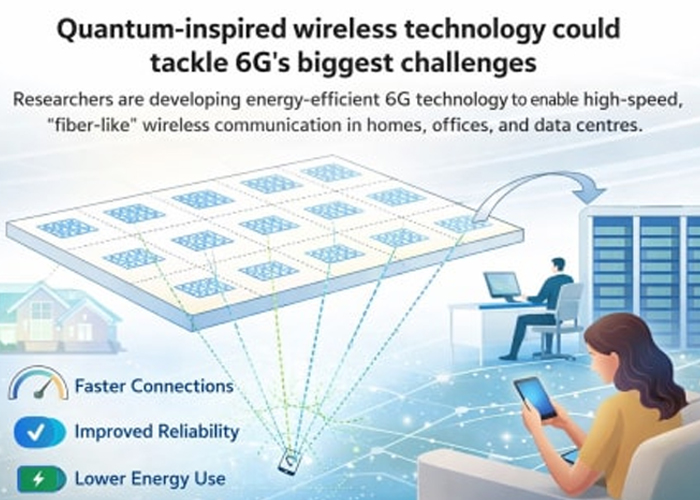
The team’s approach draws inspiration from principles used in quantum device physics, particularly the idea that many small elements can behave collectively as a single, highly directed source. Applied to optical wireless, this concept is realised through modular optical phased arrays that can precisely shape and steer signals.
Professor Thas Nirmalathas from The University of Melbourne said the modular design allows wireless systems to focus energy exactly where it is needed, reducing interference while improving efficiency. By controlling signal polarisation and direction at a fine level, the architecture can deliver high-speed, fibre-like performance without the physical limitations of wired connections.
For Chief Information Officers and technology leaders, the implications extend beyond faster connectivity. Energy efficiency and thermal management are becoming critical constraints in enterprise IT, particularly as AI workloads and edge computing increase demand on networks and data centres. Technologies that deliver higher performance while consuming less power and generating less heat align closely with sustainability and capacity planning priorities.
The researchers also emphasise scalability. Building networks from flexible, reconfigurable blocks makes it easier to expand or adapt infrastructure as demands change, without redesigning entire systems. This could be particularly relevant as organisations prepare for incremental adoption of 6G-era capabilities rather than a single, disruptive upgrade.
The work was supported through an ARC Discovery program, with significant contributions from early-career researchers including Dr Kosala Herat, now at Lund University, and Sharadhi Gunathilake at Monash.
While 6G standards and commercial deployments remain several years away, the research highlights how foundational design choices are already being shaped. For enterprise and government technology leaders, developments like this underscore that the success of 6G will depend not only on headline speeds, but on whether next-generation wireless can deliver reliable, energy-efficient performance in the real-world environments where digital infrastructure increasingly resides.