

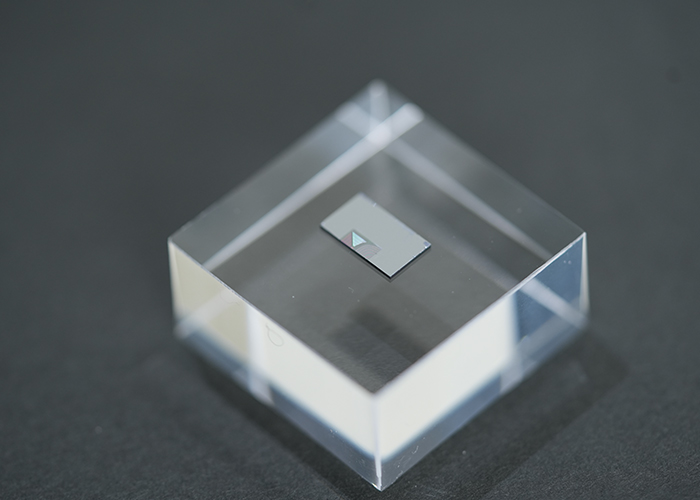
Fujitsu says it has developed a working prototype of a diamond-spin quantum computer that uses tin-vacancy (SnV) centres, rather than the nitrogen-vacancy (NV) centres typically used in diamond-based quantum approaches.
In a global release dated September 8, 2026, the company said the prototype incorporates SnV centres into photonic integrated circuits and can be operated at -271.6°C. Fujitsu contrasted this with the typical operating temperature of superconducting quantum computers, which it put at -273.13°C.
Fujitsu said it demonstrated in a test environment that the system can be accessed via its Hybrid Quantum Computing Platform “without any additional specialist knowledge”. The company positioned the work as a step toward modular quantum architectures, which aim to scale quantum systems by linking smaller quantum modules or chips through optical connections.
The prototype builds on joint research that began in 2020 with Delft University of Technology and QuTech, which is part of TU Delft. Fujitsu also said it used results from joint research with The University of Tokyo for diamond processing.
Fujitsu said it plans to develop a prototype multi-module diamond-spin quantum computer by 2027, and to begin developing technologies to integrate the diamond-spin approach with superconducting quantum computing. The company’s quantum roadmap sets an aim of practical quantum computing by 2030.
Mahesh Krishnan, Fujitsu’s chief technology officer for Oceania, said the move to tin-vacancy centres improves stability compared with nitrogen-vacancy centres, which he described as highly sensitive to outside noise.
“These tin qubits are far more stable and resistant to interference, which dramatically improves their coherence times and brings us much closer to a reliable, scalable quantum system,” Krishnan said. “For businesses here in Australia and New Zealand, it means quantum is moving out of the lab and closer to the real world.”
In Australia, Krishnan said Fujitsu has a memorandum of understanding with CSIRO and Monash University to provide Australian researchers and students with access to Fujitsu quantum computing technology and systems in Japan. He also said Fujitsu is partnering with the Australian National University to establish a quantum research facility and build an on-site quantum computer in Canberra.
In the global statement, Vivek Mahajan, Fujitsu corporate vice president and chief technology officer for system platforms, said the diamond-spin approach “has the potential to be integrated with superconducting quantum computers” to extend capabilities. He said Fujitsu’s roadmap targets a 250 logical-qubit system by fiscal 2030 and a 1,000 logical-qubit system by fiscal 2035.
QuTech general director Dr Kees Eijkel said the prototype is the result of collaborative research since 2020 and described demonstrating scalability for diamond-spin quantum computing as “a long and challenging journey”.
Fujitsu outlined three technologies it said underpin the prototype: bonding and thinning methods to prepare tin-implanted diamond substrates for use in chips; fabrication of photonics integrated circuits that integrate diamond crystals containing SnV centres with alumina optical waveguides for photon extraction during readout; and a method to convert quantum circuits into control sequences combining light, microwaves and radio-frequency waves for operation through Fujitsu’s hybrid platform.
Fujitsu said it considers SnV centres attractive because their symmetry makes them less susceptible to external noise than NV centres, and that they offer high brightness for qubit readout.