

Lenovo has announced a new generation of artificial intelligence (AI) and high-performance computing (HPC) infrastructure, including AMD EPYC-powered ThinkSystem servers, updated storage and interconnect options, Neptune liquid cooling, and expanded services aimed at enterprise and “gigawatt-scale” AI factory deployments.
The company said the portfolio is intended to address growing demand for infrastructure that can support increasingly complex AI and scientific workloads, amid constraints on data centre power, cooling and capacity.
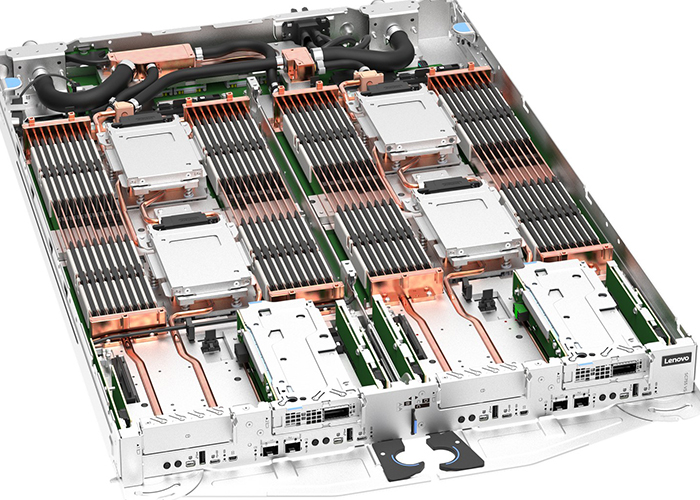
Among the new systems is the ThinkSystem SC755, a dual-socket server using Lenovo’s Neptune liquid cooling. Lenovo said the server is designed to remove up to 100% of system heat via water and deliver up to 40% higher sustained performance than similar air-cooled systems, citing internal testing and noting results may vary depending on configuration, workloads and data centre conditions.
Lenovo also introduced the ThinkSystem SR755, positioned for large-scale virtualisation and data-intensive workloads including engineering and financial modelling. Lenovo said the system is designed to deliver high compute density and memory bandwidth, and to offer lower power consumption compared with dual-socket configurations, based on internal analysis.
On the storage side, Lenovo announced the ThinkSystem DE6800 and DE6500 arrays, which it said are optimised for latency-sensitive block workloads. The company also said it has validated the Cornelis CN5000 fabric as an interconnect option for AI and HPC environments.
The new servers are powered by 6th Generation AMD EPYC 9006 SP7 processors. Dan McNamara, senior vice president and general manager, Compute and Enterprise AI at AMD, said in a statement that the platforms are aimed at workloads ranging from engineering and research to inferencing and agentic AI.
Lenovo said it is expanding its services portfolio to help organisations move from infrastructure deployment to operational AI capacity, including GPU deployment, configuration and optimisation services for hybrid AI factory environments. It said support has been expanded across Red Hat AI Enterprises, NVIDIA AI Enterprise, and NVIDIA Run:ai.
The company also announced what it described as end-to-end “gigafactory services”, including NVIDIA Infrastructure Services (NVIS) expertise for deployment and cluster validation. In addition, Lenovo said it can facilitate access to Digital Realty’s colocation data centres for organisations seeking additional data centre capacity, with Lenovo acting as a single point of contact and offering financing options through Lenovo TruScale Infrastructure as a Service.
For security and technology teams, the announcement reflects continued vendor focus on integrating compute, storage, cooling and services as AI-driven demand pushes data centres toward higher-density deployments and more complex operational requirements, particularly where scaling capacity involves hybrid and colocation environments.