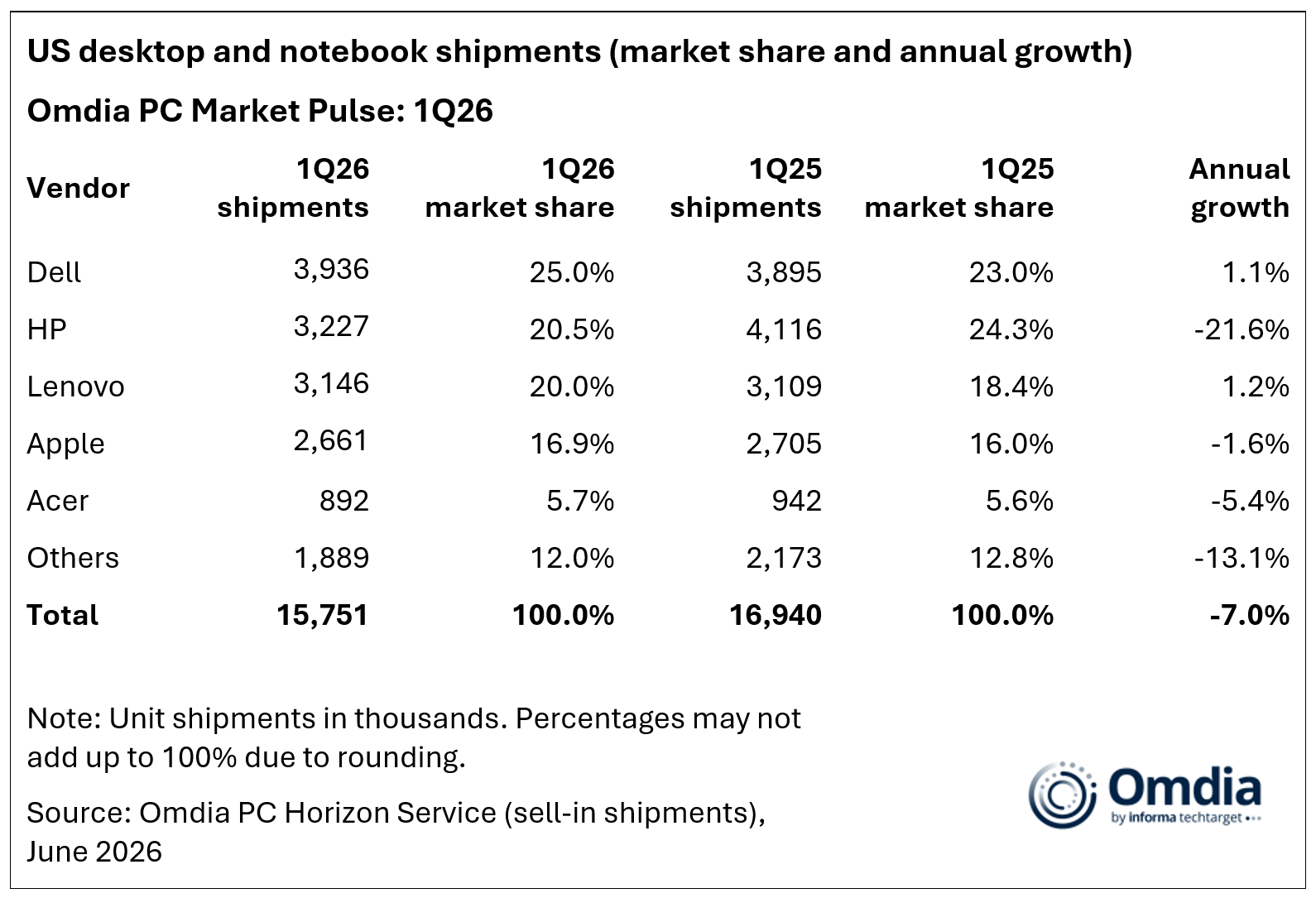


US PC shipments (excluding tablets) fell 7.0% year-over-year in Q1 2026 to 15.8 million units, according to new research from Omdia, marking the largest annual decline since Q3 2023.
Omdia attributed the downturn to component supply constraints and cost pressures from rising PC memory and storage prices, alongside weaker demand after the Windows 11 refresh cycle had exhausted much of the near-term commercial pipeline. The comparison was also influenced by a strong Q1 2025, when tariff-related inventory pull-forward inflated shipments, and by modest channel stocking in Q1 2026 ahead of anticipated memory price increases.
US PC shipments impacted by component supply constraints
With DRAM and NAND supply increasingly diverted to AI server applications, Omdia said rising component costs are eroding vendor margins on entry-level devices. Shipments of PCs priced under $500 declined 18.7% year-on-year in the quarter.
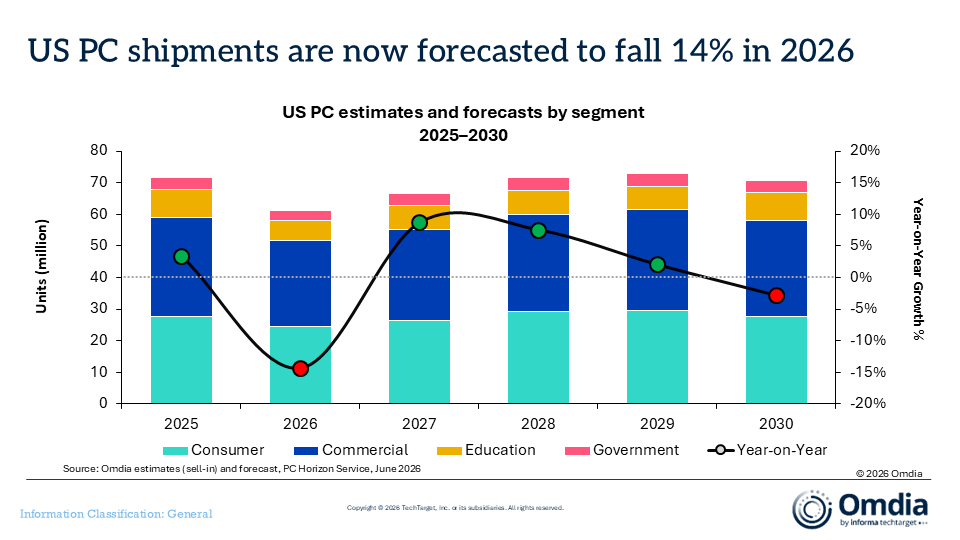
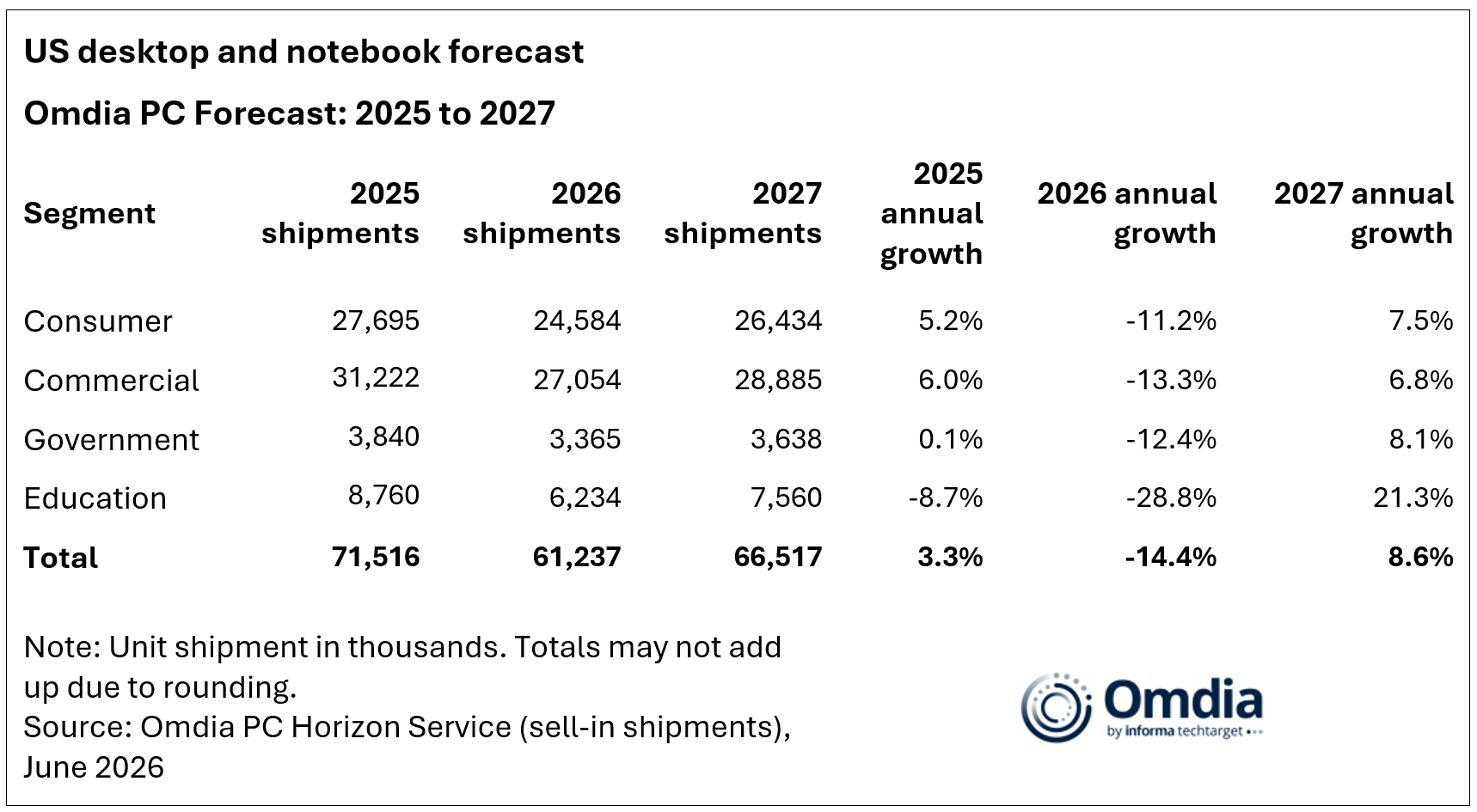
Omdia forecasts that industry-wide declines will continue through the remainder of 2026 as supply tightness persists, with full-year US PC shipments expected to fall 14.4% compared to 2025.
Business PC upgrades outpace consumer demand
“The impact of component supply constraints on PC shipments materialized in the US market in the first quarter of 2026,” said Scott Braverman, Senior Analyst at Omdia. “The consumer segment declined 9.5% year-over-year, worse than the overall market, as many consumers delayed purchase decisions amid higher price tags and challenging economic conditions. Business shipments declined by just 5.0% year-over-year, supported by remaining Windows 11 refresh activity and inventory purchases ahead of further price increases.”
According to Omdia’s May forecast, the first half of 2026 is likely to be the stronger period for business PC demand. The component cost environment is expected to keep entry-level prices elevated through 2027, suppressing consumer demand.
“Budget-constrained segments also faced pressure, although the education segment declined just 6.2% in Q1 2026,” said Braverman. “This was a significant improvement from the double-digit declines recorded in each of the previous three quarters. However, this stabilization is unlikely to hold, as rising prices disproportionately affect the entry-level devices that dominate education procurement. Government procurement also declined as price increases strained already tight public sector budgets. Both segments are expected to remain under pressure through 2026, with meaningful recovery unlikely until 2027,” added Braverman.
AI PC adoption and supply pressures drive up average selling prices
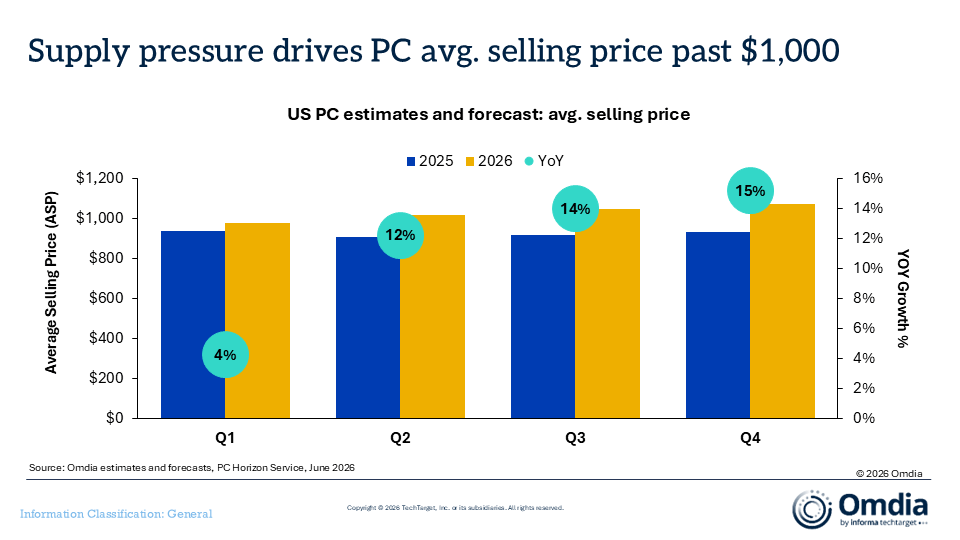
“While average selling prices rose just 4% year-on-year in Q1 2026, Omdia expects growth to reach 12% in Q2 and exceed 12% in the second half of 2026 as supply-side headwinds continue to materialize,” said Kieren Jessop, Research Manager at Omdia. “In addition, demand dynamics are also driving average selling prices higher as the share of AI-capable PCs grew to 44% of all shipments. Large enterprises in particular are increasingly procuring higher-cost AI-capable PCs.”
Business PC average selling prices are expected to grow 11% in 2026, with 10% increases in the consumer and government segments. Education average selling prices are expected to remain flat as the segment delays PC refreshes due to rapid pricing increases, Omdia said.
Vendor performance varied in Q1 2026, with Omdia citing differences in segment exposure and pricing dynamics. HP recorded a 21.6% decline in shipments and lost its top spot in the US market during the quarter. Dell took the lead with a 25.0% share, posting 1.1% growth despite the broader market contraction, while Lenovo grew 1.2% to reach 20.0% market share.
Omdia said both Dell and Lenovo benefited from consumer segment share gains of four percentage points year-on-year, narrowing the gap with Apple and HP. Apple’s shipments fell 1.6%, outperforming the overall market, and it maintained a 16.9% share as MacBook adoption continued in business segments where Omdia said Apple’s presence has grown to 15.3%. Smaller vendors saw shipments decline 13.1%, which Omdia attributed to weaker component procurement leverage than larger competitors.