

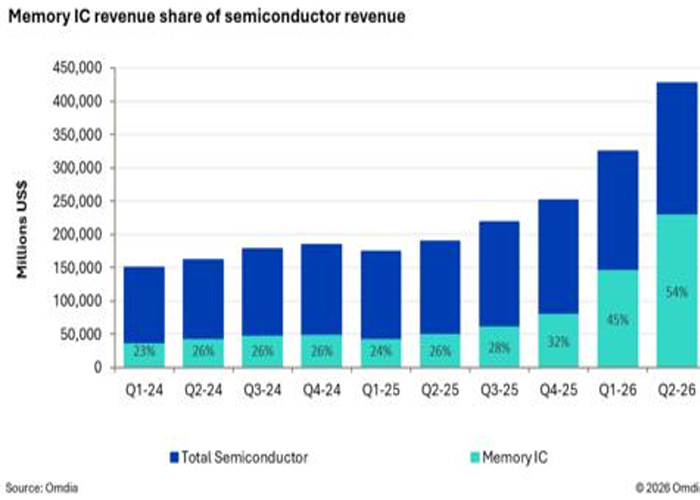
Global semiconductor revenue exceeded $425 billion in the second quarter of 2026, a quarterly record, after rising 31.4% quarter-over-quarter, according to new research from market analyst Omdia.
Omdia said demand related to artificial intelligence and strong memory pricing were the main drivers, taking total semiconductor revenue for the first half of 2026 to $752 billion. The firm said the 2Q26 sequential increase surpassed the previous record of 29.2% set in 1Q26.
Omdia, which has tracked the semiconductor market since 1Q02, said only 10 of 97 quarters have recorded sequential revenue growth above 10%. It added that the last four quarters beginning in 3Q25 have all posted double-digit sequential growth, and it expects 3Q26 to continue that pattern.
Memory was the primary driver of growth in 2Q26, with Omdia attributing the performance to DRAM and NAND flash demand tied to AI infrastructure. It said shifts in production priorities were affecting supply-demand balances, lifting average selling prices and revenue, and that memory ICs accounted for more than half of all semiconductor revenue during the quarter.
Omdia said DRAM, NAND and NOR each recorded their highest sequential growth for a second quarter since it began tracking the market, and each reached its highest recorded quarterly revenue in 2Q26.
Outside memory, Omdia said the non-memory semiconductor market grew by more than 10% quarter-over-quarter, which it described as above typical seasonal patterns. Based on Omdia data from 2002 through 2025, it said typical second-quarter sequential growth for non-memory semiconductors is just over 3%.
Microprocessor revenue grew 16% quarter-over-quarter in 2Q26, according to Omdia, compared with a seasonal growth rate of 1%, as the components play an increasing role in AI deployments.
Looking ahead, Omdia forecast semiconductor revenue would surpass $500 billion in 3Q26, pushing total revenue for the first three quarters of 2026 above $1.25 trillion. It said that would be 50% higher than total semiconductor revenue for the whole of 2025.